This StrikingColor Glass Sale will take place
Monday, June 25, 2012
--------------------------------------------------------
StrikingColor ACM5222
There was a mistake in the original listing of this glass, ACM5222. A photo of a bead made with BT400 glass was mistakenly labeled ACM5222. The description of the glass could have been better as well. The photos below are the correct ones for ACM5222 and the description has been improved. My apologies for any confusion this may have caused. Anyone who ordered this color at the June 25 glass sale may cancel their order for a full refund if they wish.
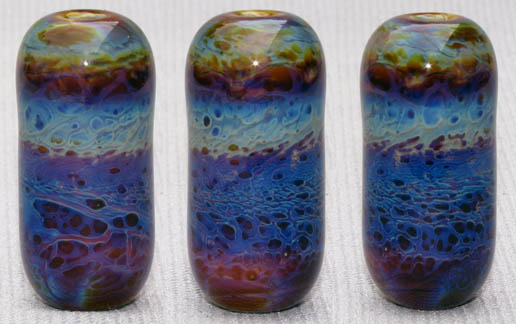
ACM5222 glass has some characteristics similar to both ACM5212 and BT400 glass. It strikes fast, showing color from dark to milky blues, purples, ambers, and cream colors, occasionally showing some pink as well. It can also give good surface webbing effects. Like BT400, it sometimes shows what one user described as "watercolor" effects. Striking can be a little tricky and the temperature at which striking is started will usually make a difference in the ease of striking and color achieved. Spot heating can also give good results. If overstruck, the striking sequence can be restarted by getting the glass very hot, cooling, and starting over. Purple colors are more likely to appear on the second or subsequent restrikes, when the glass is struck just as amber is starting to show during the cooling phase, rather than letting it get colder before striking.
The first two beads in the photos are solid ACM5222 with no other glass mixed in. The last bead was made with ACM5222 shards over Moretti/Effetre black. All were worked on a Nortel Minor torch using propane and bottled oxygen. The color variations are solely due to the striking characteristics of the glass.
|
|
|
StrikingColor ACM5222 glass. Different views of the same bead. |
|
|
|
StrikingColor ACM5222 glass. Different views of the same bead. |
|
|
|
StrikingColor ACM5222 shards over Moretti/Effetre black. Different views of the same bead. |
--------------------------------------------------------
StrikingColor CM6222
CM6222 does not seem to exhibit as wide a range of color as some of my other glasses. It mainly strikes to shades of blue and purple/blue and can give some very nice purples. It also tends to strike uniformly, rather than showing the color striations and variation that some of my other glasses show when a bead is made by laying down glass at various temperatures. The best way to get color variations in this glass is by spot heating once the bead has been shaped. If overstruck, the striking sequence can be restarted by getting the glass very hot, cooling, and starting over. The beads in the photos are solid CM6222 with no other glass mixed in. All were worked on a Nortel Minor torch using propane and bottled oxygen. The color variations are solely due to the striking characteristics of the glass.
|
|
|
StrikingColor CM6222 glass. Different views of the same bead. |
|
|
|
StrikingColor CM6222 glass. Different views of the same bead. |
|
|
|
StrikingColor CM6222 glass. Different views of the same bead. |
--------------------------------------------------------
StrikingColor CM4252
StrikingColor CM4252 glass tends to strike to rich, dark colors with a strong tendency for surface webbing of color. Starting the striking sequence over again once it has overstruck is fairly easy and usually leads to increased surface webbing of color. Anyone who has used some of the early "type A" StrikingColor glasses will recognize the way this glass works. It is very similar to those glasses. Like my earlier type A glasses, the cane itself is primarily opaque, although some of it has an opaque surface and very dark amber core.
|
|
|
StrikingColor CM4252 glass. Different views of the same bead. |
|
|
|
StrikingColor CM4252 glass. Different views of the same bead. |
|
|
|
StrikingColor CM4252 glass. Different views of the same bead. |
--------------------------------------------------------
StrikingColor SLA423
StrikingColor SLA423 glass can strike to rich, dark colors or pale pastels, depending on how it is worked. Pastels seem to be the norm on restriking. Of the glasses on this page, SLA423 is probably the most difficult to strike consistently. Unless you are proficient with silver striking glasses, this might not be the best choice for you.
|
|
|
StrikingColor SLA423 glass. Different views of the same bead. |
|
|
|
StrikingColor SLA423 glass. Different views of the same bead. |
|
|
|
StrikingColor SLA423 glass. Different views of the same bead. |
|
|
|
StrikingColor SLA423 glass. Different views of the same bead. |
--------------------------------------------------------
StrikingColor ACM5212
StrikingColor ACM5212 glass is very similar to the earlier ACM-521 glass. ACM5212 cane is opaque with a multi-colored surface. It strikes hard and fast, showing good color that tends towards dark to milky blues, dark amber/browns, and cream color. As can be seen in the sample bead photos below, it shows good surface webbing and color variations. Striking can be a little tricky and striking before it gets too cold, just as amber is starting to show in spots, seems to give the best results. The beads below are solid ACM5212.
|
|
|
StrikingColor ACM5212 glass. Different views of the same bead. |
|
|
|
StrikingColor ACM5212 glass. Different views of the same bead. |
|
|
|
StrikingColor ACM5212 glass. Different views of the same bead. |
--------------------------------------------------------
Please keep in mind that these descriptions are merely guidelines. Silver glasses in general have a well deserved reputation for being unpredictable. The descriptions above are my impressions of the working characteristics of each of the various glasses after making test beads with them on a Nortel Minor torch using bottled oxygen and propane and a neutral to oxidizing flame. Those people using other setups may have different results, as will those who work the glass differently. For that reason it is impossible to predict what a particular glass might do in your hands. (Most the time I can't even get the same results out of the same rod of glass twice in a row.) So some experimentation on your part is likely to be required for the best results.
With that said, here are some general guidelines:
The variations in color shown in the sample bead photos are primarily due to variations in the heating and cooling of different parts of the beads. Because it is easier to vary the heating on a larger or longer bead these glasses will usually give better color variation on those type of beads, rather than on a standard, small round bead. Since a small round bead tends to stay a relatively uniform temperature throughout while being worked, there will be less variation in the color. One can intentionally spot-heat parts of that type of bead to help overcome this, but it is still difficult to get enough temperature variation to get a wide variety of colors in a small bead. For this reason, silver glasses will usually produce better results on larger/longer beads.
They can also produce some nice color variation on beads made with a metal bead press, particularly flattened or diamond shaped beads. One suggestion I would have for those making flattened types of beads is to give a quick shot of a hot, sharp flame to the middle of the bead. Then let it cool a bit and very gently heat the entire bead. I've seen some very nice color patterns produced like this. But as always, experimentation is the best way to determine what works well with your particular setup.
There can be a color shift if beads made with striking silver glasses are annealed at too high a temperature. Annealing at a lower temperature for a longer time will usually minimize any color changes. I personally batch anneal at 915F for an hour or an hour and a half for average sized beads. However, not all temperature readouts are accurate and not all annealers have an even heat distribution, so the ideal temperature and time for your particular equipment may be different than mine. Some testing with different time/temperature profiles may be necessary.