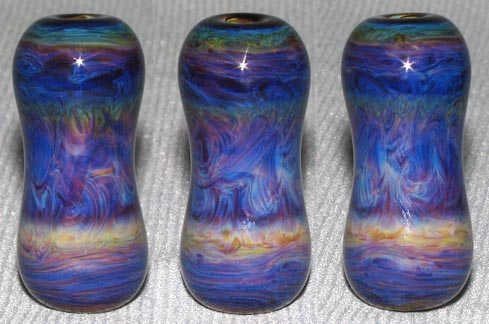
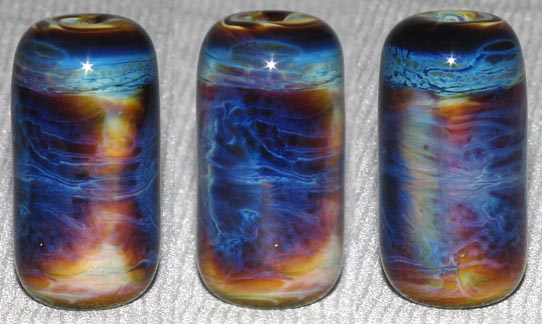
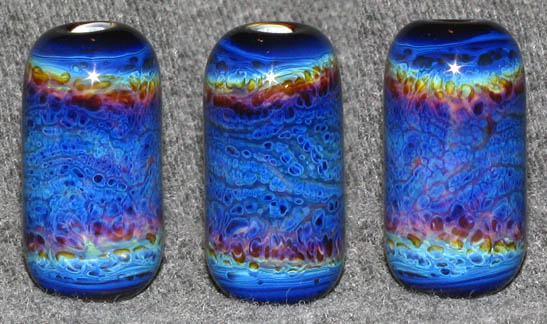
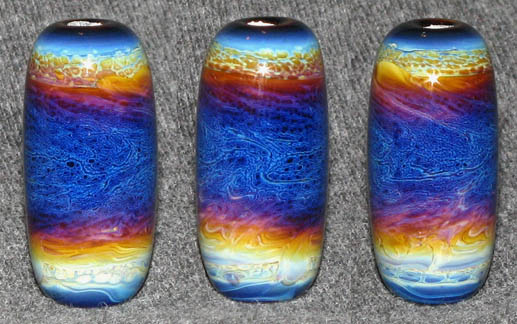
This OffSpec Glass Sale will start
Tuesday, July 31, 2012
at approximately 9pm Eastern time
in the StrikingColor ArtFire Store
--------------------------------------------------------
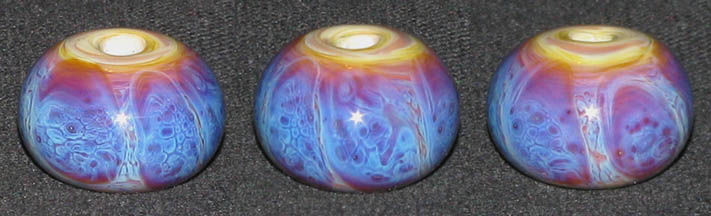
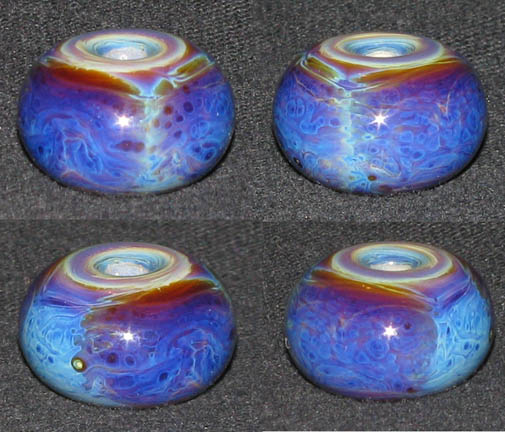
OffSpec418C
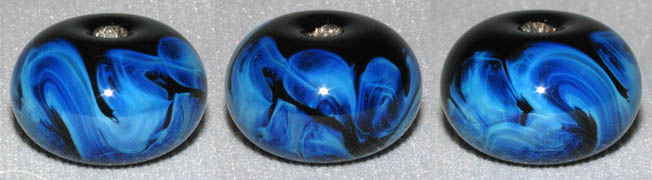
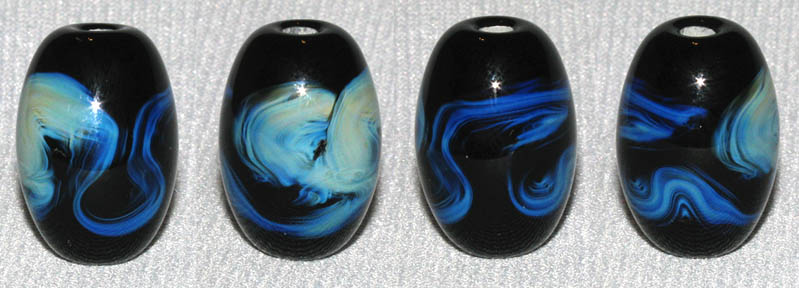
OffSpec418C was originally designed to be used as decoration over a black background glass. While not really "offspec", striking can be unpredictable and the color range is quite limited, so it was decided to include it in this sale. Compatibility with "104 COE" glasses is good. The photos below show it used over a base of Moretti/Effetre black. Unlike most StrikingColor glass this one is not meant to be used alone. If used by itself it usually overstrikes quickly to an opaque tan/cream color and can be hard to "reset" to get it to strike again. But used as intended over a black background, it can give some very nice wispy, translucent blues.
|
|
|
OffSpec418C glass over Moretti/Effetre black. Different views of the same bead. |
|
|
|
OffSpec418C glass over Moretti/Effetre black. Different views of the same bead. |
--------------------------------------------------------
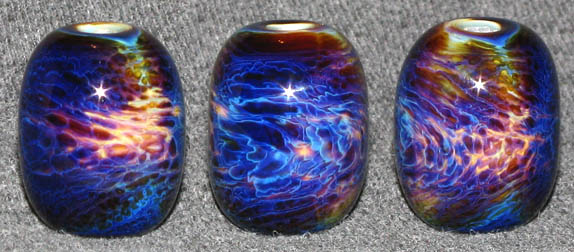
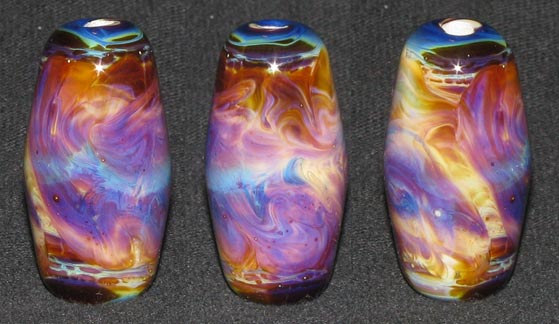
OffSpec5312E
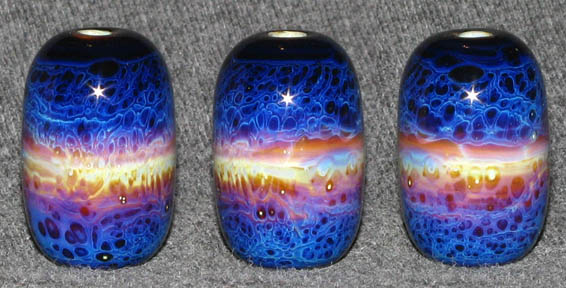
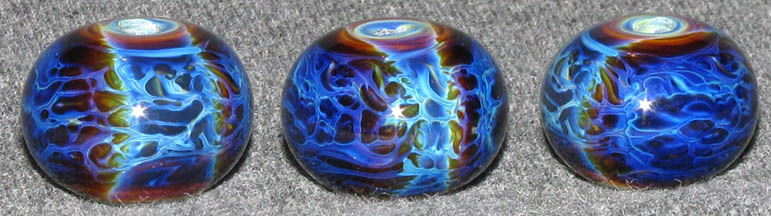
OffSpec5312E has a tendency to strike to fairly dark shades of blue, purple/blue, and amber. Under the right circumstances it can give some nice surface effects and webbing. If overstruck, the striking sequence can be restarted by getting the glass very hot, cooling, and starting over. It was deemed offspec due to the compatibility being borderline and the color being a little dark.
The beads in the photos are solid OffSpec5312E with no other glass mixed in. All were worked on a Nortel Minor torch using propane and bottled oxygen. The color variations are solely due to the striking characteristics of the glass.
|
|
|
OffSpec5312E glass. Different views of the same bead. |
|
|
|
OffSpec5312E glass. Different views of the same bead. |
|
|
|
OffSpec5312E glass. Different views of the same bead. This bead is a good illustration of the tendency of this color to strike fairly dark. |
--------------------------------------------------------
OffSpec5112C
Offspec5112c was deemed offspec due to the color and difficulty in striking. The color tends to be a bit light, leaning strongly to pastels. It can be a little too easy to wind up with a cream color that is difficult to restrike, or a very pale blue. Light fuschia, pale blue, or light to dark amber are fairly common colors. Getting it to strike away from the cream color can take a little work. This glass does not have any compatibility problems. It is offspec due primarily to striking difficulties and somewhat due to the light color (which I actually like myself).
|
|
|
Offspec5112C glass. Different views of the same bead. |
|
|
|
Offspec5112C glass. Different views of the same bead. |
|
|
|
Offspec5112C glass. Different views of the same bead. |
--------------------------------------------------------
OffSpec4022E
OffSpec4022E glass tends to strike to fairly dark, muted, and earthy colors. The compatibility with 104 glass is not good. On the other hand, it can give some good surface effects and webbing if handled right and tends to show the patterns in which the color was laid down on the bead. Because of the compatibility issue, I strongly recommend using it alone rather than trying to mix it with another glass.
|
|
|
OffSpec4022E glass. Different views of the same bead. |
|
|
|
OffSpec4022E glass. Different views of the same bead. |
--------------------------------------------------------
OffSpec5412E
OffSpec5412E glass is very similar in color and striking characteristics to CM6222 glass. It doesn't exhibit as wide a range of color as some of my other glasses and mainly strikes to shades of blue and purple/blue. It can also give some nice purples. Like CM6222, OffSpec5412E tends to strike uniformly, rather than showing the the color striations and variations that some other StrikingColor glasses show when a bead is made by laying down glass at varying temperatures. The best way to get color variations in this glass is by spot heating once the bead has been shaped. While it will show surface webbing, the webbing strongly tends to be "fine grained", rather than large scale. If overstruck, the striking sequence can be restarted by getting the glass very hot, cooling, and starting over. This glass is offspec due to borderline compatibility.
|
|
|
OffSpec5412E glass. Different views of the same bead. |
|
|
|
OffSpec5412E glass. Different views of the same bead. |
--------------------------------------------------------
Please keep in mind that these descriptions are merely guidelines. Silver glasses in general have a well deserved reputation for being unpredictable. The descriptions above are my impressions of the working characteristics of each of the various glasses after making test beads with them on a Nortel Minor torch using bottled oxygen and propane and a neutral to oxidizing flame. Those people using other setups may have different results, as will those who work the glass differently. For that reason it is impossible to predict what a particular glass might do in your hands. (Most the time I can't even get the same results out of the same rod of glass twice in a row.) So some experimentation on your part is likely to be required for the best results.
With that said, here are some general guidelines:
The variations in color shown in the sample bead photos are primarily due to variations in the heating and cooling of different parts of the beads. Because it is easier to vary the heating on a larger or longer bead these glasses will usually give better color variation on those type of beads, rather than on a standard, small round bead. Since a small round bead tends to stay a relatively uniform temperature throughout while being worked, there will be less variation in the color. One can intentionally spot-heat parts of that type of bead to help overcome this, but it is still difficult to get enough temperature variation to get a wide variety of colors in a small bead. For this reason, silver glasses will usually produce better results on larger/longer beads.
They can also produce some nice color variation on beads made with a metal bead press, particularly flattened or diamond shaped beads. One suggestion I would have for those making flattened types of beads is to give a quick shot of a hot, sharp flame to the middle of the bead. Then let it cool a bit and very gently heat the entire bead. I've seen some very nice color patterns produced like this. But as always, experimentation is the best way to determine what works well with your particular setup.
There can be a color shift if beads made with striking silver glasses are annealed at too high a temperature. Annealing at a lower temperature for a longer time will usually minimize any color changes. I personally batch anneal at 915F for an hour or an hour and a half for average sized beads. However, not all temperature readouts are accurate and not all annealers have an even heat distribution, so the ideal temperature and time for your particular equipment may be different than mine. Some testing with different time/temperature profiles may be necessary.